I think the area which i was influenced more in was cinematography, particualrly by Shrooms and The Blair Witch Project.
Shrooms has a similiar theme of drugs in it (although they are recreational) and so the use of an effect called 'Shutter speed' gave my group 2 fantastic POV shots which they use on characters to show what state they are in. Shrooms also has an aerial shot in a forest which is so effective and gives so much impact that it made me/my group want to try it, so one of my group stood on a tree stump with the tripod and camera fully extended and the shot looked really great. In the end though due to continuity we couldn't use it - there were no trees in this aerial shot but where we shot the chase there were lots of trees either side. Shrooms also had some really effective side tracks from behind trees (i.e. the trees maskd the view of the characters sometimes) - which we also did and used in one shot which fades into a title as it goes behind the tree.
I loved the Blair Witch Project camerawork because it was jumpy and chaotic it mae the situation even more jumpy, our camera work was quite shakey because obviously we had to run with the camera but i think the effect is amazing. The diegetic sound in the Blair Witch Project is also brilliant, i rewatched the ending of it without the sound to understand what was going on (it was too scary with the sound) and it made so much less impact. The diegetic sound really does make the film, so i personally spent a lot of time trying to perfect our diegetic sound to give greater effect.
Showing posts with label Inspiration. Show all posts
Showing posts with label Inspiration. Show all posts
Thursday, January 31

Thursday, November 1
The Blair Witch Project
I watched The Blair Witch Project on Halloween and it was one of the most scary films i think I've ever seen (apart from possibly the Saw series), and the amazing thing was that afterwards i realised that you never actually see anything scary, the whole film plays on the audience's imagination. It's also quite inspiring because it's similar to the thriller i will create in that it was very low budget of around £2000 - cheap for a cinema screened film of course.
I think the most effective factor of the film is the iconography:
Setting
Set in a large forest it provides the scariness factor of shadows, noises in the night time and total isolation - i think this isolation plays on audience fears the most therefore making it even more thrilling. This is all also emphasised by the fact that they are lost and are in unknown territory.
Mise-en-Scene
Is generally very dark - this provides the unknown factor again, the lack of glamour to their clothes and general look adds realism to the film/story so it makes it seem more believable and therefore scary.
Camera
Is entirely handheld (or at least on a very shaky track) so it heightens the sense of their isolation from the world because it allows the audience to suspend their belief and think that there isn't a film crew there. At some points the screen is just black because it is night and they don't want to turn their lights on, and i think this panics the audience a little. It's almost like a break from having to close your eyes in fright but at the same time you want them to turn a light on in case something jumps out - so it dramatically increases the suspense.
Colour
Is all natural browns and greens - which adds realism again. Then sometimes when it's black + white it makes it seem supernatural and almost adds glamour - in an old movie style way. By glamour i mean something out of the ordinary - they seem to have very normal lives and i think the black + white symbolises this extraordinary event (also could be put into 'camera')
Rating: ****
I think the most effective factor of the film is the iconography:
Setting
Set in a large forest it provides the scariness factor of shadows, noises in the night time and total isolation - i think this isolation plays on audience fears the most therefore making it even more thrilling. This is all also emphasised by the fact that they are lost and are in unknown territory.
Mise-en-Scene
Is generally very dark - this provides the unknown factor again, the lack of glamour to their clothes and general look adds realism to the film/story so it makes it seem more believable and therefore scary.
Camera
Is entirely handheld (or at least on a very shaky track) so it heightens the sense of their isolation from the world because it allows the audience to suspend their belief and think that there isn't a film crew there. At some points the screen is just black because it is night and they don't want to turn their lights on, and i think this panics the audience a little. It's almost like a break from having to close your eyes in fright but at the same time you want them to turn a light on in case something jumps out - so it dramatically increases the suspense.
Colour
Is all natural browns and greens - which adds realism again. Then sometimes when it's black + white it makes it seem supernatural and almost adds glamour - in an old movie style way. By glamour i mean something out of the ordinary - they seem to have very normal lives and i think the black + white symbolises this extraordinary event (also could be put into 'camera')
Rating: ****
Monday, October 29
Techniques: Continuity Editing
For all films with all genres in order to make it seem real to the audience and to make the action seem continuous there are certain rules/techniques that a film maker must follow. These rules ensure that the film seems to be in real time.
Rules
Camera

30 Degree Rule
If the camera switches shot but has more or less the same framing (i.e. changes by less than 30 degrees) then the camera seems to jump and it makes the clip seem jumpy and amateur.
Eyeline Match
This ensures that the clip is realistic, so for example if one character is tall than the other, the short one is seen to be looking up and the taller one down.
Match On Action
During action, for example a car moving or a person running, if you decide to cut to another angle or distance then it is important that in the second shot the car/person appears to have moved. Otherwise the action (car moving/person running) seems to repeat.
Shot/Reverse/Shot
This rule is for shooting a conversation
1st shot: Master shot - both characters
2nd shot: CU character 1
3rd shot: CU character 2
Further shots: BCU to show emotion MS can also be used
Editing
Transitions
Rules
Camera
Shot Order
So that it makes sense you need to move your audience across space smoothly by using a logical order, for example:
LS to MS to CU
Jumping straight from first to last is a little disorientating and should only be used to effect
180 Degree Rule
In a scene there is a 180 degree line which the camera goes up and down but does not actually cross, this is one rule which is never broken because the effect it produces is only confusion. It is mainly applicable during conversations because if the camera crosses the line the 2 subjects appear to be looking in the same direction.
30 Degree Rule
If the camera switches shot but has more or less the same framing (i.e. changes by less than 30 degrees) then the camera seems to jump and it makes the clip seem jumpy and amateur.
Eyeline Match
This ensures that the clip is realistic, so for example if one character is tall than the other, the short one is seen to be looking up and the taller one down.
Match On Action
During action, for example a car moving or a person running, if you decide to cut to another angle or distance then it is important that in the second shot the car/person appears to have moved. Otherwise the action (car moving/person running) seems to repeat.
Shot/Reverse/Shot
This rule is for shooting a conversation
1st shot: Master shot - both characters
2nd shot: CU character 1
3rd shot: CU character 2
Further shots: BCU to show emotion MS can also be used
Editing
Transitions
- Cuts are most common for seamless movement from one shot to another, creates pace and rhythm
- Dissolves provide a slow and relaxing atmosphere (sometimes for a montage effect). Can also be used to show time moving forward and to show a relationship between 2 shots.
- Fading (up/out/to black/from black) shows a significant amount of time passing
- Wipes aren't conventionally used in film, mainly for children's television
Sound
Diegetic
This heightens the realism of the film for the audience as it makes it seem more like the real world
Non-Diegtic
Music can alter the mood dramatically, and is particularly effective at creating suspense because it lets the audience know that something is about to happen. Voice over's aren't very common in films but if they are present they help the audience understand/empathise.
Sound Bridge
This is a way to link 2 scenes quite effectively. It is when the picture and diegetic sound change at different times. Conventionally the sound from the second scene is heard before the picture is shown.
Thursday, September 27
Inspiration
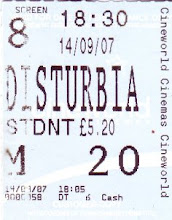
Rear Window and Disturbia have given me so much inspiration for my thriller!
I really really love the idea of a normal setting - probably suburban (don't know why) - and then something really twisted and warped going on behind closed doors. I think it's a great chance to be creative and i think it also taps into fears of the audience right now which is a big part of a successful thriller. So i think most of my initial ideas will be based around this area.
Some other examples are:
- Lantana
- Blue Velvet
I really really love the idea of a normal setting - probably suburban (don't know why) - and then something really twisted and warped going on behind closed doors. I think it's a great chance to be creative and i think it also taps into fears of the audience right now which is a big part of a successful thriller. So i think most of my initial ideas will be based around this area.
Some other examples are:
- Lantana
- Blue Velvet
Subscribe to:
Posts (Atom)